Every year on 22nd March, World Water Day arrives with statistics, campaigns, and urgent appeals. We read them, nod seriously, maybe share a post, and then return to ordinary life. A tap opens. A bottle is refilled. A shower runs a little longer than needed. And water, once again, becomes invisible.
But perhaps that is the real problem.
Water is so present in our daily lives that we forget how precious it is. We measure it in litres, pipelines, and bills, but rarely in gratitude, consciousness, or responsibility. This is where a more meaningful reflection on World Water Day must begin: not only with environmental concern, but also with inner awakening.
Let us begin with a few facts that make us pause.
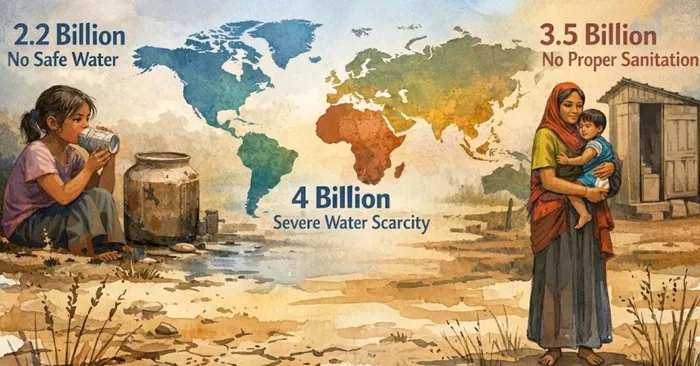
Around 2.1 to 2.2 billion people globally still lack safely managed drinking water, and 3.4 to 3.5 billion people still lack safely managed sanitation. Around 1 in 4 people still do not have safe drinking water, while 1.7 to 2 billion people lack basic hygiene services at home. UNICEF also reports that 4 billion people experience severe water scarcity for at least one month each year.
This year’s global focus adds another important layer. World Water Day 2026 centres on “Water and Gender”, reminding us that access to safe water and sanitation is not only an environmental concern, but also a matter of dignity, equality, and human rights. So the water crisis is not only about thirst. It is about the hidden burden of scarcity — the time it steals, the health it risks, and the dignity it quietly erodes.
One of the deeper reasons behind this crisis is another form of shortage: a shortage of reverence.
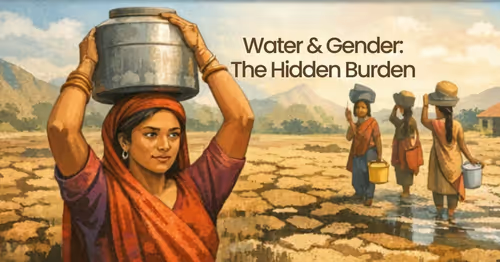
UN Theme for 22 March 2026: Water and Gender
The United Nations theme of World Water Day 2026, “Water and Gender,” reminds us that access to safe water is not only about sustainability, but also about dignity, equality, and who carries the heaviest burden when water is missing. Official UN material for 2026 emphasizes that a rights-based approach to water must include women’s equal voice, leadership, and opportunity in water governance. This sharpens the environmental message rather than softening it. It reminds us that water scarcity is never only about water. It also affects education, health, safety, time, opportunity, and self-respect.
Why Water Matters More Than Ever
Most of us notice water fully only when it is interrupted — a dry tap, a delayed tanker, a shortage notice, a summer of rationing. Until then, it fades into the background of life, and that is exactly what makes it easy to waste.
Modern society has more information about water than ever before. We have data, warnings, campaigns, technology, and policy. Yet waste continues. Why? Because information can guide behaviour, but it does not always transform consciousness. People do not misuse water only because they are careless with infrastructure. Very often, they are careless in attention.
When the mind is rushed, consumption becomes automatic. When life is built around convenience, excess starts to feel normal. When gratitude is absent, abundance is taken for granted.
This year, on World Water Day 2026, we need practical water conservation more than ever. But that becomes truly lasting only when we change the way we see water itself.
Water Is Not Only a Resource, It Is a Relationship
A powerful truth is: the way we treat water reflects the way we see life.
If water is seen only as a utility, it becomes something to consume. But when it is seen as precious, life-giving, and shared, it becomes something to honour.
This is where the essence of Brahma Kumaris thought brings depth to the conversation. It is about recognising that outer waste often begins with inner disconnection. Because once the inner lens changes, even ordinary actions begin to change.
A person who sees nature as precious or worthy, will not waste casually.
A person who practices silence becomes more aware.
A person who values simplicity naturally consumes less.
A person who remembers that the self is a peaceful soul is less likely to live in restless excess.
This is practical spirituality.
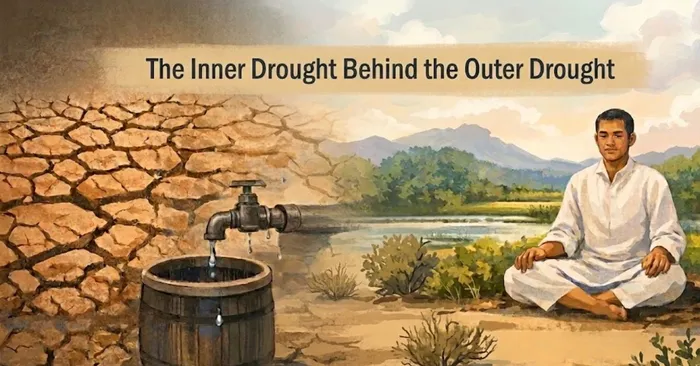
The Inner Drought Behind the Outer Drought
There is an outer drought in many parts of the world. But there is also an inner drought in modern life: a drought of contentment, restraint, and reverence.
We often talk about the water crisis in terms of climate, policy, population, and infrastructure. Those are real causes. But there is another factor we rarely name directly: a drought of contentment, restraint, and regard. We use more because we desire more, rush more, and reflect less. Today, the root of many outer problems lies in body-consciousness: the belief that happiness comes mainly through possessions, comfort, status, and sensory fulfilment.
In contrast, soul-consciousness brings a different quality of living: peace, self-respect, moderation, and compassion. People who are inwardly stable tend to live more thoughtfully and waste less.
That is why water conservation is not only technical. It is ethical and behavioural.
Spirituality for Sustainability
Spirituality does not replace science or policy; it strengthens the awareness that makes responsible action sustainable.
Brahma Kumaris teachings on simplicity, inner peace, purity, and self-awareness offer a framework for sustainable living without reducing it to dry instruction. It suggest that water conservation does not begin only in reservoirs, pipelines, and institutions. It also begins in the mind that chooses restraint over indulgence, gratitude over entitlement, and awareness over habit.
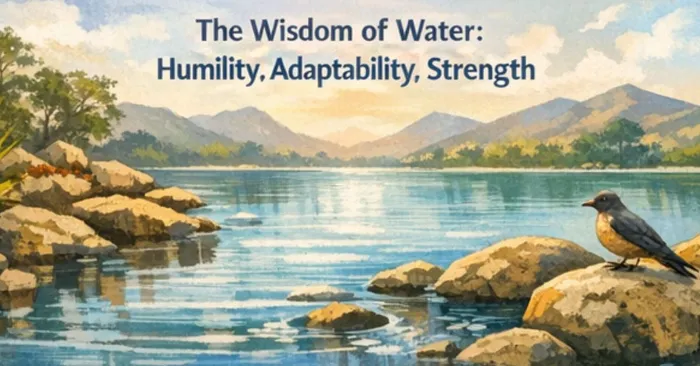
What Water Can Teach Us About Humility, Adaptability, and Strength
Water is one of nature’s quietest teachers.
- It teaches humility. It flows downward, serving silently and reaching where it is needed most.
- It teaches adaptability because it does not lose its essence when circumstances change; whether held in a clay pot, a riverbank, a cloud, or a copper vessel, it remains water.
- It teaches persistence because it transforms the world without aggression. Over time, it smooths rock, nourishes roots, shapes landscapes, and sustains life — not through force, but through steady presence.
In a restless world, that lesson matters. Water shows us that gentleness is not weakness. Constancy is not passivity. In fact, many of the most powerful changes in life happen exactly this way: slowly, silently, faithfully.
This insight also carries a spiritual echo. The Brahma Kumaris wisdom often emphasizes qualities like humility, purity, patience, and inner stability. This is a state of alignment.
When thoughts are cleaner, choices become cleaner.
When intention is pure, relationship with matter becomes gentler.
Such inner qualities naturally make one environmentally responsible—not because they are forced, but because their consciousness no longer permits casual harm.
The Five Elements and a More Reverent View of Nature
Whether one reads this literally, or symbolically: nature is not separate from us.
Water flows through our bodies, our homes, our crops. It is both practical and profound. It cleans, nourishes, cools, carries, restores, and connects. Once we begin to see it this way, waste stops feeling small. Every careless act starts to reveal a mindset behind it.
Watch Video
Practical Water Conservation for Daily Life
- At home, water conservation begins with small disciplines that are fully within our control. Turn taps off while brushing, washing, or scrubbing. Fix leaks quickly. Reuse water where safe and practical. Avoid unnecessary over-washing of floors, driveways, or vehicles. Store water carefully rather than wasting it through overflow.
- In the kitchen, respect food as much as water. Cooking more than needed, throwing away leftovers, or wasting ingredients also wastes the water used to grow, transport, and prepare them. A simpler, cleaner, more thoughtful food culture indirectly protects water too.
- In communities, schools, and centres, visible culture matters. Put simple reminders near taps. Encourage rainwater harvesting where feasible. Normalise gratitude and restraint instead of excess. Celebrate responsible habits quietly but consistently.
None of these steps are dramatic. That is exactly why they matter. The water crisis is made of millions of daily actions, and so is the solution.
Conclusion: The Change Begins With the Way We Live
On World Water Day 2026, it is easy to talk about what governments, systems, and industries should do. But real change also begins much closer to home: in mindset, habit, and daily choice.
When the self becomes more peaceful, actions become less wasteful.
When life becomes simpler, consumption becomes lighter.
When awareness rises, excess falls.
We may not solve the global water crisis alone, but we can stop contributing to it unconsciously.
Because the future of water will not be shaped only by policy documents and global conferences. It will also be shaped by kitchens, bathrooms, schools, gardens, habits, and values. It will be shaped by whether human beings learn again to live with respect for what sustains them.
So let this World Water Day 2026 be more than a slogan. Let it become a reset in the way we live. Let it remind us that water is not merely available; it is invaluable. Let it remind us that every drop deserves dignity. And let it move us toward the kind of life that is both practical and elevated: careful in action, clean in intention, simple in lifestyle, and sincere in responsibility.
Saving water is not only an environmental act. It is a human act. A value-based act.
Explore Brahma Kumaris Environment Initiatives
Discover how the Brahma Kumaris Environment Initiative brings together inner awareness and practical action through meditation, water management, renewable energy, tree projects, waste management, and sustainable living principles.
Learn More