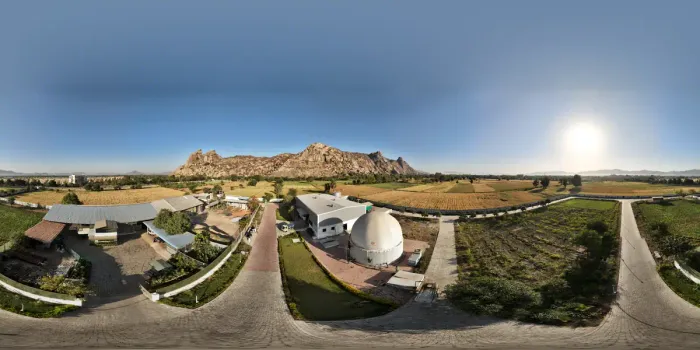
Mount Abu lies in the beautiful valleys of the Aravalli hills.
In these peaceful surroundings is the world-famous international headquarters of the Brahma Kumaris. It is a divine place where thousands of people come every day to experience deep peace and God’s love. People arrive from India and abroad to receive spiritual knowledge for the right direction in life and to increase inner strength through Rajyoga. For everyone who comes here, food, accommodation, and service facilities are provided smoothly and with ease.
A Vast Campus and the Challenge of Waste
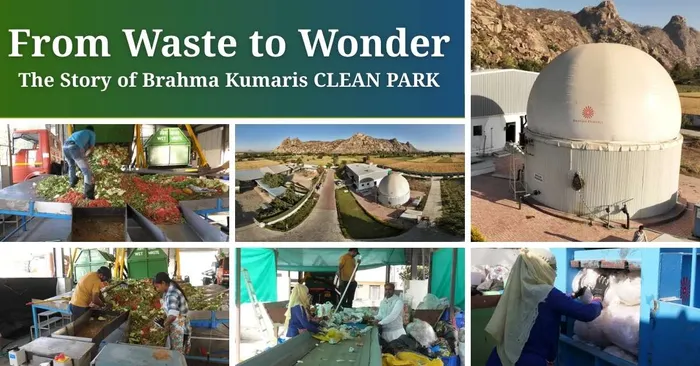
But in such a large campus, how is the waste generated every day managed effectively and in an environment-safe way? This itself is a very inspiring story. Turning this challenge into an opportunity,
Brahma Kumaris established the Clean Park in 2024. This is not just a system—it is a green and clean revolution that ensures 100% utilization of the waste collected daily in the campus.
Right Waste, Right Dustbin
This entire system begins with a very simple but extremely important habit— putting the right waste into the right dustbin.
Across the campus, green and blue dustbins have been placed.
The green dustbin is for wet and organic waste.
The blue dustbin is for dry and recyclable waste.
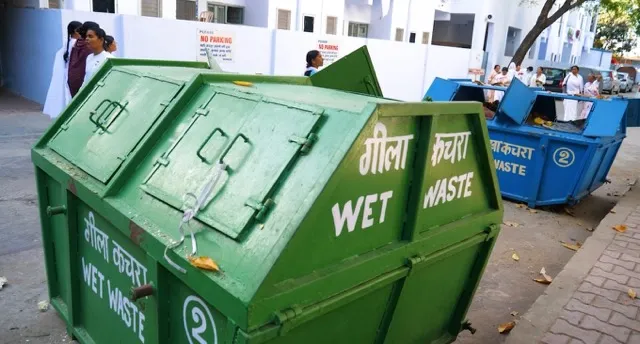
This small habit makes the entire scientific process ahead smooth and highly effective.
The Journey of Waste to Clean Park
After the waste is separated, premium hydraulic vehicles collect wet and dry waste separately from across the campus and bring it to the Clean Park. From here begins the process that converts waste into energy and compost.
Process of Generating Energy from Wet Waste
Wet waste is processed here daily with a capacity of 3 to 4 tons. First, it is checked on a large table. Then it is cut into small pieces in a shredder. In a juicer, it is turned into pulp, and then it is made uniform in a mixing pit.
Wet Waste Extraction
This mixture is sent through a pipeline to the center of the Clean Park— to a 200,000-liter capacity biogas anaerobic digester.
A Living Energy Center : The Biogas Digester
This structure—9 meters in diameter, 4 meters in height, fitted with a high-torque mixer and a double-layer gas holder membrane—is not just a machine. It is a living energy center.
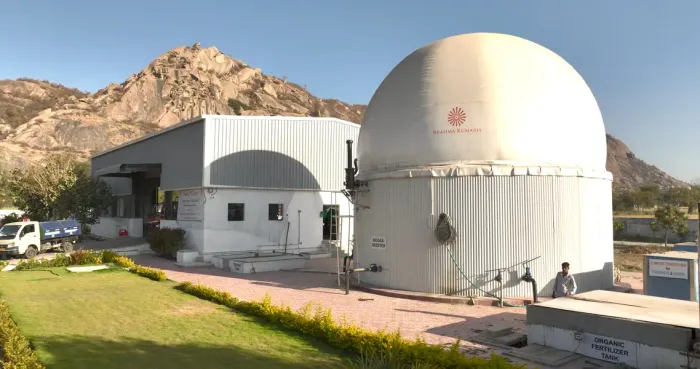
Here every day:
300 to 400 cubic meters of biogas, and
150 to 200 units of environment-friendly electricity are produced.
This electricity is used within the campus, and the organic compost produced is sent to the Brahma Kumaris’ large farms and gardens.
New Life Energy for Soil and Plants
Organic compost gives new life energy to plants. The health of the soil becomes richer and stronger. In this way, wet waste does not get “destroyed”—it becomes a means to nourish life.
Complete Utilization of Dry Waste
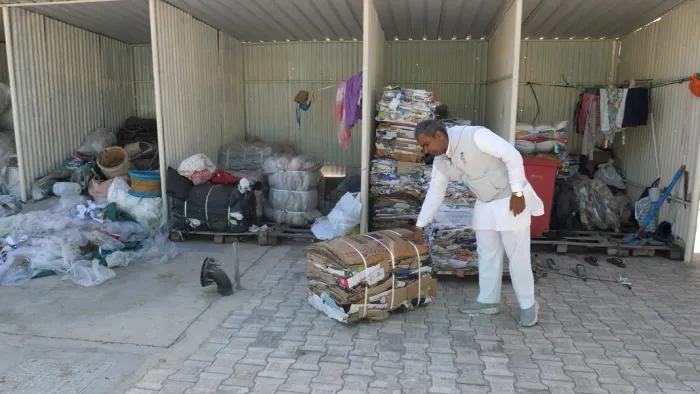
In the same way, dry waste is also not allowed to go to waste here. The waste from the blue dustbins goes through detailed sorting on a conveyor table. Here, paper, cardboard, metal, plastic, and glass are separated.
Dry and Recyclable Waste
After that, these are compressed in a baling machine and sent to recycling units, where they are converted again into useful resources.
Baling Machine
Safe Solution for What Cannot Be Recycled
Items that cannot be recycled—such as masks, hand gloves, and napkins—are handled through a large incinerator installed here. These items are destroyed in an environment-safe manner. Most importantly, the smoke that comes out is treated through a wet scrubber and purified completely, so that there is no negative impact on the air.
An Ideal Zero-Waste Model
Today, the Brahma Kumaris Clean Park stands before the world as an ideal zero-waste model. This model not only converts waste fully into useful resources, but also gives society a message that sustainable development, cleanliness, and cooperation with nature are not just ideas—they can become a beautiful way of life.
A Gift for Future Generations
Clean Park is not just a system.
It is a gift for future generations— a living example of a clean, healthy, and sustainable lifestyle.