
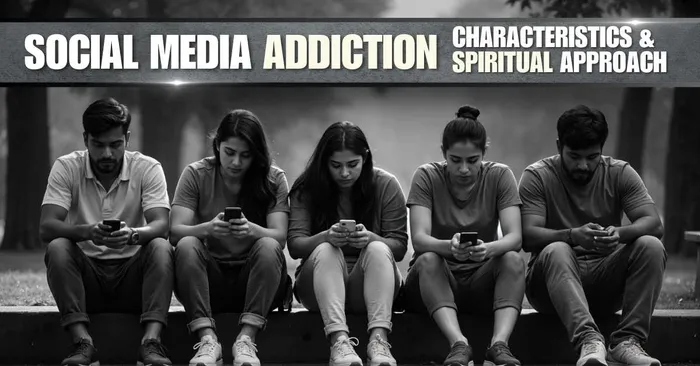
Social media addiction can feel like mindless scrolling you didn’t plan—yet it keeps happening. Have you ever told yourself “just 5 minutes” and suddenly lost an hour? Many platforms are built to keep attention locked in, which can slowly turn into a source of stress, anxiety, comparison, and digital dependence.

Understanding the characteristics of social media addiction is the first step toward regaining control. When we recognize how social media platforms influence our psychology, we can begin creating a healthier and more mindful relationship with technology. Here, we’ll explore why social media is so compelling, and how we can gradually break free from its grip, inspired by spiritual practices that help foster self-mastery and digital wellbeing.
Why Social Media Is So Addictive
Social media platforms are carefully designed using behavioural psychology and reward systems to keep users engaged for longer periods. These features trigger the dopamine effect of social media, which plays a major role in social media habit formation.
Below are some of the most powerful characteristics of social media addiction.

Lack of an “End Queue” – Endless Scrolling Addiction
Imagine reading a book or watching a movie. Both have a clear ending. Eventually the story concludes, giving your brain a natural stopping point.
Social media works differently.
Platforms like Instagram, Facebook, and Twitter (X) operate with an infinite scrolling system, meaning there is no final page or end point. New posts continuously appear every second, making it difficult for the brain to recognize when to stop. This design encourages the thought:
"Just one more post… just one more scroll."
Without a natural endpoint, the brain keeps searching for something interesting. This endless content loop can make users lose track of time and unknowingly spend hours scrolling through feeds. Psychologists often compare this to walking through a maze with no exit, where every turn promises something new and exciting.
Instant and Random Rewards – Dopamine and Social Media Addiction
One of the strongest drivers of social media addiction psychology is the dopamine reward system.
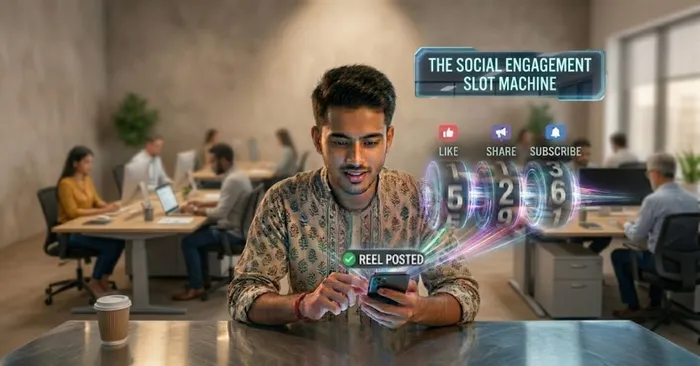
Whenever you post a photo, story, or message, you receive likes, comments, shares, and new followers. However, these rewards appear randomly and unpredictably. This randomness is powerful.
It works in the same way as a slot machine in a casino.
Each time you check your phone, your brain anticipates a reward. When a notification appears, your brain releases dopamine, the chemical associated with pleasure and motivation. Even when the reward is small, the anticipation itself becomes addictive. This cycle encourages users to repeatedly check their phones, hoping for the next burst of validation or interaction.

Constant Notifications – The Attention Trap
Notifications are another major contributor to social media addiction and digital distraction. Every notification sound, vibration, or red badge signals that something new is happening online. These alerts are intentionally designed to capture attention immediately. Even when ignored, notifications can create low-level psychological tension in the mind. Thoughts like:
“Who liked my post?”
“Did someone message me?”
“Am I missing something important?”
This subtle curiosity pulls our attention away from real-life activities and encourages us to check our phones repeatedly. Over time, this can condition the brain into an automatic habit of checking social media, even when there is no real need.

Comparison and Validation – The Social Media Self-Worth Trap
Another powerful feature that fuels social media addiction and anxiety is the constant culture of comparison and validation. Most people share only the best moments of their lives online: vacations, celebrations, achievements, and curated photos. When we see these highlight reels, it is easy to start comparing our own lives. This comparison can lead to:
• feelings of inadequacy
• low self-esteem
• jealousy or envy
• fear of missing out (FOMO)
At the same time, social media publicly displays likes, reactions, and follower counts, turning validation into measurable numbers. Gradually, some people begin to connect their self-worth with social media approval, forgetting that personal value cannot truly be measured by digital metrics.

Echo Chambers and Information Overload
Social media algorithms are designed to show users content similar to what they previously engaged with. This creates what psychologists call an echo chamber. In an echo chamber, people mostly see opinions that match their own beliefs, limiting exposure to diverse viewpoints.
At the same time, social media constantly delivers massive amounts of information news updates, advertisements, memes, opinions, trending topics. Our brains are not built to process such continuous streams of information. This overload can cause:
• mental fatigue
• anxiety
• decision fatigue
• constant distraction
Ironically, when overwhelmed by information, many people keep scrolling in search of something meaningful—yet often end up feeling more drained.
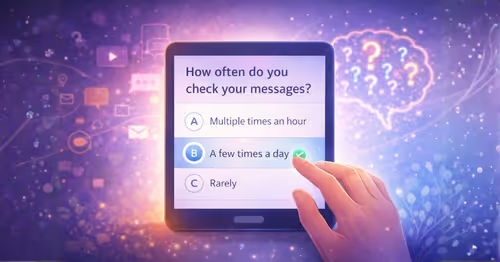
Are You Digitally Balanced? Find Out Now!
Take this quick Digital Wellness Assessment to understand how your social media habits affect your focus, emotional wellbeing, and daily life. In just a few minutes, discover whether your digital habits are balanced or if small mindful changes can help you build healthier screen time and better digital boundaries.
Take the AssessmentHow Can you Break Free from the Social Media Addiction





Simple Practices to Break Free from Social Media Addiction
Breaking social media addiction habits does not require quitting technology entirely. Instead, small changes can help us develop healthier digital boundaries.
Setting Boundaries – Creating Your Own “End Queue”
One simple technique is to create an intentional stopping point. Set a timer for social media use, such as:
• 15 minutes after lunch
• 20 minutes in the evening
When the timer ends, close the app. This practice trains the brain to recognize clear digital limits, reducing endless scrolling.
Mindful Engagement – Breaking the Reward Cycle
Whenever you feel the urge to check your phone, pause for a moment. Take a few deep breaths and ask yourself:
"Do I really need to check this right now?"
Even small pauses help break the automatic habit of checking notifications. Another effective strategy is removing social media apps from your phone and accessing them only through a computer or browser.
Turning Off Notifications – Practicing Digital Silence
Reducing notifications can significantly improve digital wellbeing. Turn off non-essential alerts, promotional notifications, social media reminders. This simple step reduces distractions and allows your mind to focus more peacefully on daily activities.
Gratitude Practice – Building Self-Worth Beyond Comparison
Instead of seeking validation online, strengthen your inner appreciation. Every day, write down three things you feel grateful for. These may include personal qualities, meaningful experiences, small achievements.
Gratitude helps shift attention away from comparison and toward inner contentment.
Offline Exploration – Reconnecting with Real Life
One of the most effective ways to reduce social media dependence is by engaging in offline activities. Try spending time to read books, walk in the nature, have meaningful conversations and do physical exercise.
These experiences provide real joy and mental refreshment, something social media cannot fully replace.

Spiritual Perspective for Digital Wellbeing
Spiritual wisdom can provide powerful guidance for managing social media addiction and mental stress. The Brahma Kumaris, a global spiritual organization focused on inner transformation, teach practices that help individuals develop self-mastery, peace, and digital balance.
- Soul Consciousness – Recognizing Inner Worth
Social media often encourages body consciousness, where identity is based on appearance, status, or popularity. Brahma Kumaris teachings emphasize soul consciousness, understanding ourselves as spiritual beings full of peace and love.
- Practice affirmation:
"I am a peaceful soul. My value is not measured by likes or followers."
This awareness builds inner confidence independent of social media validation.
- Rajyoga Meditation – Finding Inner Peace
Rajyoga meditation is a simple form of open-eye meditation practiced by the Brahma Kumaris. It helps reconnect with inner qualities like peace, pure love, power and clarity. Practicing Rajyoga for 5–10 minutes daily can reduce mental restlessness and decrease the urge for constant digital stimulation.
- Detachment – Becoming an Observer
Detachment does not mean avoiding social media completely. Instead, it means using it without emotional dependency. When posting online, remind yourself:
"I share this without attachment to the outcome."
This mindset reduces anxiety related to likes, comments, and reactions.
- Self-Respect and Inner Dignity
True self-worth comes from inner qualities, not external approval. Practicing affirmations such as:
"I am complete as I am."
helps build stable self-esteem that is not influenced by social media metrics.
- Service (Seva) – Using Social Media Positively
Instead of using social media only for self-promotion, it can also be used for positive contribution. You can share uplifting messages, encourage others, and promote kindness. This transforms social media from a source of validation into a platform for meaningful service.
- Daily Spiritual Knowledge – Strengthening Awareness
Regular spiritual study strengthens inner clarity and awareness. Reading spiritual teachings each morning helps align the mind with higher values and peaceful thoughts, naturally reducing the pull of digital distractions.
Building a Peaceful Relationship with Social Media
Understanding the characteristics of social media addiction allows us to interact with technology more consciously. By combining digital boundaries, mindfulness, and spiritual practices, we can transform our relationship with social media.
Instead of being controlled by endless scrolling and comparison, social media can become a tool for connection, learning, and positivity. When awareness increases, inner peace grows—and the power of digital distractions begins to fade.